
Eye Movement Desensitization and Reprocessing (EMDR) therapy is a powerful
psychological treatment designed to help individuals process and heal from traumatic experiences. Unlike traditional talk therapy, which can be time-consuming and often requires the individual to verbalize every detail of their trauma, EMDR leverages the brain's natural healing processes to expedite recovery. This is achieved through bilateral stimulation, a technique that engages both hemispheres of the brain, facilitating the reprocessing of traumatic memories.
Closure: Each session ends with closure to ensure the client feels stable and safe. If the memory is not fully processed, the therapist guides the client through grounding techniques and coping strategies to manage any residual distress until the next session.
Reevaluation: At the beginning of subsequent sessions, the therapist reevaluates the client’s progress and any remaining distress associated with the memory. New target memories may be identified as treatment progresses.
How EMDR Works:
History Taking and Treatment Planning: The therapist gathers a comprehensive history of
the client’s experiences and identifies target memories for treatment. A treatment plan is
created based on the client's specific needs and trauma history.
Preparation: The therapist explains the EMDR process to the client and ensures they have
the necessary coping mechanisms to deal with emotional disturbances that may arise
during therapy. This phase focuses on building a sense of safety and trust.
Assessment: The target memory is assessed, including the vividness of the memory,
associated negative beliefs, and emotional and physical reactions. The therapist helps the
client identify a positive belief to replace the negative one.
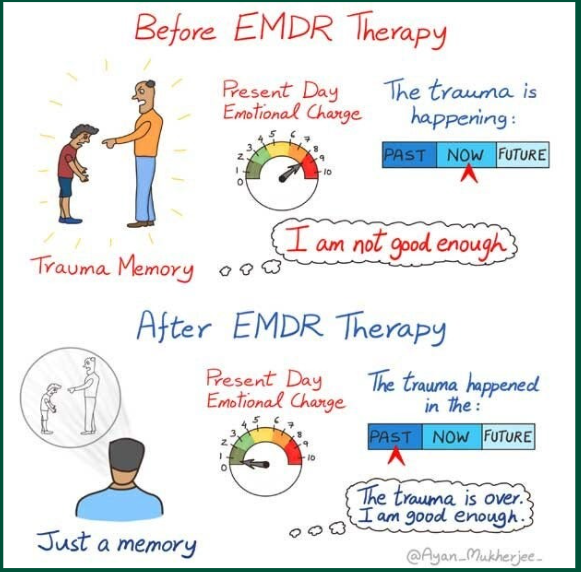
Desensitization: This phase involves the core of EMDR therapy—bilateral stimulation. The
therapist guides the client through sets of eye movements, taps, or auditory tones while
the client focuses on the traumatic memory. Bilateral stimulation helps the brain
reprocess the memory, reducing its emotional charge.
Installation: Positive beliefs are strengthened to replace the negative beliefs associated
with the traumatic memory. The therapist continues bilateral stimulation while the client
focuses on the positive belief.
Body Scan: The therapist checks for any residual physical tension or distress related to
the memory. Further bilateral stimulation may be used to address any remaining
discomfort.